
Getting approved for a business credit card is harder than most new business owners expect, and the biggest reason is personal credit score. Credit score business card approval is not just about your revenue or how long you have been in business. It comes down to your personal FICO score, and knowing that changes everything about how you prepare. This guide walks you through the exact score thresholds you need, how to strengthen your credit profile before applying, and what to do after approval to protect the credit you have worked to build.
Table of Contents
- Understanding credit score requirements for business credit cards
- Preparing your credit profile for business card approval
- Step-by-step process to apply for a business credit card
- Managing your business credit card to build and protect credit
- The overlooked truth about credit scores and business card approval
- How Credifixr supports your business credit and card approval journey
- Frequently asked questions
Key Takeaways
| Point | Details |
|---|---|
| Personal credit matters most | Your personal FICO score is the biggest factor in business credit card approval, often outweighing business age or revenue. |
| Match cards to your credit | Choosing a business card that fits your credit score range increases your chances of approval. |
| Monitor and improve credit | Regularly check credit reports and keep payments on time with low utilization to boost your score. |
| Prepare and apply carefully | Gather necessary info, use preapproval tools, and expect personal credit hard inquiries when applying. |
| Manage cards wisely | Pay balances early to lower utilization reports and protect both personal and business credit health. |
Understanding credit score requirements for business credit cards
Most people assume business credit cards evaluate your business separately from you as an individual. They don't. Most business credit cards require a personal FICO score starting at 690 for good card options, though fair credit alternatives and secured cards exist for lower scores. Your personal credit history is the primary signal issuers use to decide whether you are a reliable borrower.
Here is how the score ranges typically break down:
| Credit range | Score | Card options | Approval likelihood |
|---|---|---|---|
| Poor | Below 630 | Secured business cards only | Low, requires deposit |
| Fair | 630 to 689 | Limited unsecured cards (e.g., Capital One Spark Classic) | Moderate |
| Good | 690 to 719 | Most standard business cards | Good |
| Excellent | 720 and above | Premium rewards cards | High |
Capital One is a useful reference point because they publish tiered requirements. Capital One business cards have estimated FICO requirements starting at 580 to 640 for entry-level cards, 690 to 719 for mid-tier cards, and 720 and above for premium cards. That tiered structure mirrors the industry broadly.
Key things to know about business credit score requirements:
- Good credit (690+) opens the door to most standard business cards with rewards and travel perks
- Fair credit (630 to 689) gives you access to entry-level unsecured cards with lower limits and fewer benefits
- Poor credit (below 630) means secured cards are your most realistic path, requiring a cash deposit as collateral
- Excellent credit (720+) qualifies you for premium cards with higher limits, sign-up bonuses, and better rates
- No credit history is treated similarly to poor credit, so building business credit from scratch starts with personal credit first
The credit score impact on card apps is real and immediate. A 30-point difference can move you from rejection to approval, or from a secured card to an unsecured one with actual rewards.
Now that you know what credit scores you need, let's look at how to prepare before applying for a business credit card.
Preparing your credit profile for business card approval
Preparation is where most applicants skip steps and pay for it later. Before you submit a single application, you need a clear picture of where your credit stands across all three bureaus: Equifax, Experian, and TransUnion. Pull your reports at AnnualCreditReport.com, which is the only federally authorized free source. Poor personal credit is one of the main reasons small business credit applications are declined, and monitoring your reports weekly helps you catch problems before they cost you an approval.
Here is what to focus on when building your credit profile for business card approval:
- Payment history (35% of your score): This is the single biggest factor. One missed payment can drop your score significantly. Set up autopay for at least the minimum on every account.
- Credit utilization (30% of your score): Keep balances below 30% of your available credit. If your limit is $10,000, keep your balance under $3,000. Keeping balances low and paying on time is the fastest way to move your score.
- Credit history length: Older accounts raise your average account age. Do not close your oldest credit card even if you rarely use it.
- New credit inquiries: Each hard inquiry drops your score a few points. Space out applications by at least six months.
- Credit mix: Having a mix of revolving credit (cards) and installment loans (auto, student) helps your score modestly.
These are the core credit improvement strategies that move the needle before you apply.
Pro Tip: Pay your credit card balances before the statement closing date, not just before the due date. Issuers report your balance to the bureaus on the closing date, so paying early means a lower balance gets reported, which lowers your utilization and can boost your score within 30 days.

With your credit profile in good shape, let's move on to the step-by-step application process for a business credit card.
Step-by-step process to apply for a business credit card
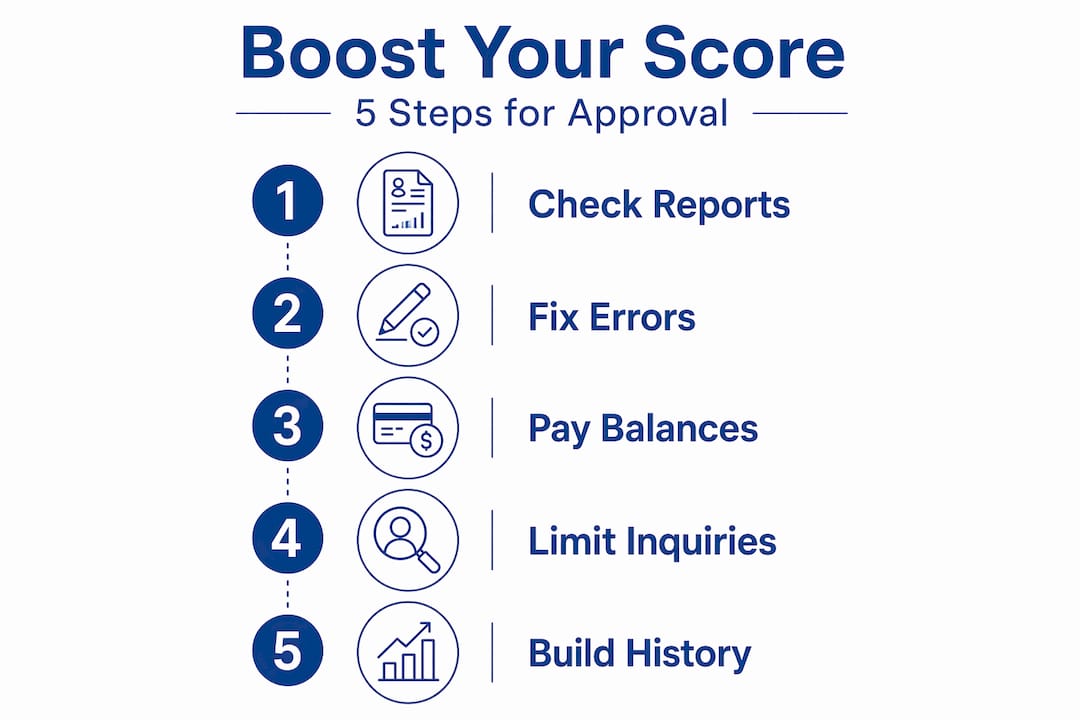
Knowing the process removes the guesswork and helps you avoid mistakes that cost you points or result in rejection. Here is how to approach it:
- Review your credit reports. Pull reports from all three bureaus and dispute any errors before applying. Inaccurate late payments or incorrect balances can drag your score down unfairly.
- Choose a card that fits your credit profile. Applying for a premium card when your score is 660 is a guaranteed hard inquiry with no reward. Match the card to your current score range.
- Gather your documents. You will need your Social Security number, business name and address, estimated annual revenue, and industry type. Sole proprietors can use their SSN as their business tax ID.
- Submit your application. Applying for a business card involves a personal hard inquiry, which causes a temporary small score drop and stays on your report for two years. Approval can be instant or take up to 30 days.
- Use the card strategically from day one. Approval is not the finish line. How you use the card from the first billing cycle shapes your credit profile going forward.
| Step | Action | Why it matters |
|---|---|---|
| 1. Prepare | Review all three credit reports | Catch errors before they cause rejection |
| 2. Choose | Match card to your credit score | Avoids wasted hard inquiries |
| 3. Apply | Submit with accurate business info | Incomplete info delays or denies approval |
| 4. Wait | Expect instant to 30-day decision | Some issuers review manually |
| 5. Use | Make small purchases, pay in full | Builds positive payment history immediately |
Capital One pulls all three credit bureaus and considers existing customer relationships when making approval decisions. If you already have a personal card with an issuer, that relationship can work in your favor.
Pro Tip: Many major issuers offer preapproval or prequalification tools on their websites. These use a soft inquiry (which does not affect your score) to show you which cards you are likely to qualify for. Use them before committing to a full application.
After applying, it's important to understand how to manage your business credit card to build credit and maintain good standing.
Managing your business credit card to build and protect credit
Approval is the beginning, not the goal. How you manage your card over the next 12 to 24 months will either strengthen your credit profile or quietly damage it.
"Business card applications trigger personal hard inquiries even for LLCs due to the personal guarantee requirement."
That personal guarantee means your personal credit is on the line every time you use your business card. Business cards require a personal guarantee, so good management impacts both your business and personal credit reports simultaneously.
Best practices for managing your card after approval:
- Always pay on time. Even one late payment can drop your score 50 to 100 points. Autopay is your safety net.
- Keep utilization under 30%. If your business card limit is $5,000, keep your balance under $1,500 at statement time.
- Pay before the statement closing date. Paying before statement closing can report 0% utilization and potentially increase your score by 20 to 50 points monthly.
- Review both credit reports regularly. Business card activity can show up on your personal report. Check for errors on both.
- Understand the personal guarantee. If your business cannot pay, you are personally liable. This is not a technicality. It is a real financial risk.
Pro Tip: Use your business card for small, predictable recurring expenses like a software subscription or monthly utility. This keeps the card active, builds payment history, and keeps your balance low and manageable.
Consistent business credit management over time is what turns a fair credit profile into a good one, and a good one into an excellent one.
Now that you know how to manage your card, here's our unique perspective on credit scores and business card approvals that you won't find elsewhere.
The overlooked truth about credit scores and business card approval
Here is what most guides won't tell you directly: your business revenue and time in business are largely irrelevant for most business credit card approvals. Personal credit is the biggest approval factor, and new businesses qualify mostly on the owner's FICO score because revenue and time in business matter less to card issuers than they do to banks making loans.
This matters because it changes where you should invest your energy. Spending six months trying to grow revenue before applying for a business card is less effective than spending those same six months cleaning up your personal credit report and paying down utilization.
"Personal credit score is the biggest factor for business credit card approvals. Time in business and revenue don't matter for most business card issuers."
We have seen business owners with $200,000 in annual revenue get rejected for a basic business card because of a 620 personal credit score. And we have seen sole proprietors with zero business revenue get approved for a solid rewards card because their personal score was 730. The pattern is consistent.
The other thing most people skip is monitoring all three bureaus, not just one. Each bureau can have different information, and a derogatory mark on Experian that does not appear on TransUnion can still cost you an approval if your target issuer pulls Experian. Checking all three before you apply is the difference between a surprise rejection and a confident, informed application.
Secured cards and fair credit cards are not consolation prizes. They are the practical stepping stones that build the payment history and utilization track record you need to qualify for better cards in 12 to 18 months. Treat them as tools, not limitations.
How Credifixr supports your business credit and card approval journey
Getting your credit in shape for a business card takes consistent effort, and having the right tools makes that process significantly more manageable. Credifixr is built for exactly this kind of work, helping you track your financial health, manage cash flow through better invoicing, and stay on top of the factors that influence your creditworthiness.
When your cash flow is organized and your invoicing is timely, you are less likely to miss payments or carry high balances, which directly supports your credit profile. Credifixr's invoice management features help you get paid faster, which means you have the funds to pay your card balances on time and keep utilization low. Explore Credifixr's business credit growth strategies to see how the platform can complement everything you have learned here and support your path to stronger credit and better card approvals.
Frequently asked questions
What personal credit score do I need to get approved for a business credit card?
Most business credit cards require a personal FICO score of at least 690, though entry-level options are available for scores as low as 580. Capital One's tiered requirements range from 580 to 640 for basic cards up to 720 and above for premium cards.
Can I apply for a business credit card if my personal credit is poor?
Yes, but your realistic options are secured business credit cards or cards designed for fair credit. Poor credit below 630 means secured cards are your best path to establish business credit and build toward better options.
Does applying for a business credit card impact my personal credit score?
Yes. Applying triggers a hard inquiry on your personal credit report, which can temporarily lower your score by a few points and remains on your report for two years.
What are the best ways to improve my credit score before applying for a business credit card?
Pay every bill on time, keep credit utilization under 30%, avoid closing old accounts, and check your credit reports for errors. Payment history and utilization are the two factors that move your score the fastest when managed consistently.